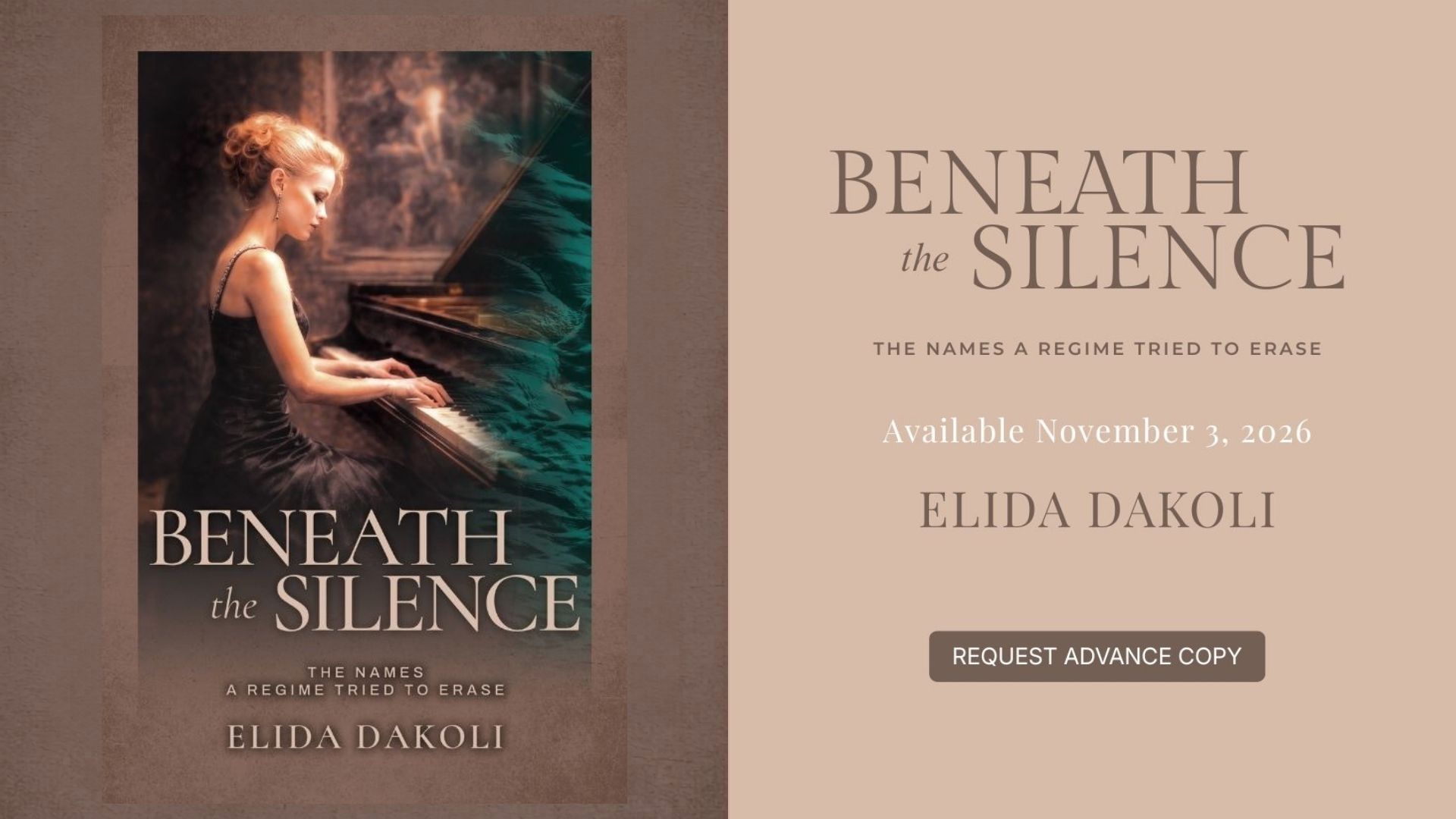






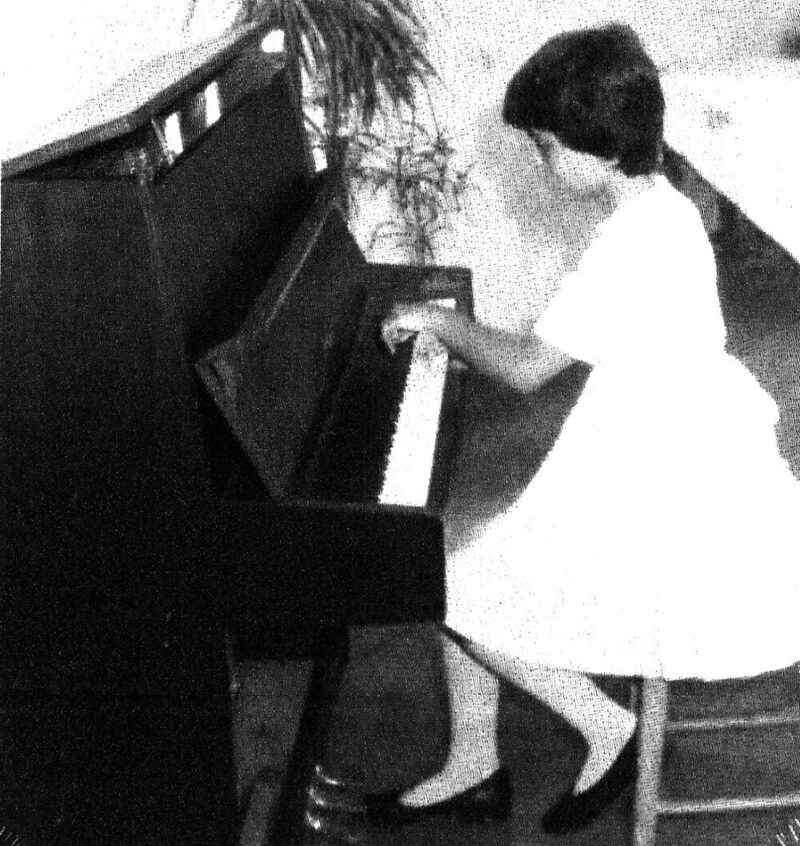
It begins with a paper keyboard.
A child pressing silent keys,
imagining sound where it was not allowed.
In a country where silence meant survival, a family learned to live with what could not be said, and what could not be forgotten.
Beneath the Silence traces three generations shapes by political persecution, memory, and the quiet persistence of identity.
It is a story not only of what was endured, but of what was carried forward, through music, through discipline, and through the refusal to disappear.
Read an excerpt
From Chapter One: My Prelude
Durrës, 1984
My shoes were too small.
I had known this for months, but there were no new shoes to be had. So, I curled my toes inward and walked on the edges of my feet, trying to make room where there was none. The leather bit into my heel with every step. By the time we reached the music school, a blister had already formed, hot and wet under my skin.
I didn’t tell Mami. Pain was not something we discussed in our family. You felt it, you carried it, you kept walking.
The hallway stretched before us like a throat. Gray walls. Gray floor. Gray light filtering through a barred window high above. Dust floated in the narrow beams, suspended, going nowhere. The doors we passed were heavy and old, their glass panes fogged with age, each one sealed with iron locks the color of dried blood. Behind them, I could hear piano scales. Muffled. Distant. The sound of children who had already been chosen.
I gripped Mami’s hand tighter.
Her fingers were warm, her grip steady, but I could feel her pulse against my palm. Fast. Constant. A drumbeat of fear she would never admit to. In our world, mothers didn’t show fear. They showed strength, even when there was none left. Especially then.
I was six years old. This was my audition. My one chance to become what I had always wanted to be.
We had walked twenty minutes from our apartment, but it felt like crossing into enemy territory. The Mujo Ulqinaku School of Music was a building designed to intimidate. Plain concrete. Small windows. Walls thick enough to swallow screams. Nothing in Communist Albania was built for beauty. Buildings were built for function. For control. For the quiet reminder that you were small and the state was vast, and your dreams existed only with permission.
If I passed today, I would be allowed to study piano.
If I failed, that door would close. Not just for me. For my family. For the Dakoli name that already carried too much weight, too much suspicion, too much history the Party wanted erased.
My great-uncle Cia had seen it first. When I was barely old enough to walk, he would watch me tap my fingers against tables, against walls, against anything that might make sound.
“Oh, Jaja!” he would say to my grandmother, his voice rising with delight. “This one will be a pianist. Like my Shpresa. I can already see it.”
Shpresa. His daughter. The legend of our family. Director of the piano department at this very school. When people in Durrës spoke her name, they spoke it softly, reverently, the way they might speak of a saint.
To me, she was something more. She was proof that a person from our world could become something. Could rise. Could play.
I don’t remember choosing to want the piano. The wanting was simply there, like hunger, like breath. Maybe Uncle Cia planted it. Maybe it grew from watching Jaja’s face whenever she mentioned Shpresa. Or maybe it came from the piano itself. The glimpses I caught through half-open doors. The gleaming black surface. The white and black keys lined up like teeth. The sound that poured out when someone touched them. A sound that seemed to come from somewhere else entirely. Somewhere clean. Somewhere free.
In Durrës, pianos were rare. Only the school had them. Only the chosen could play. The rest of us pressed our ears against locked doors and imagined.
For months, Mami and I had come to this hallway to prepare. We couldn’t afford lessons. We couldn’t touch the instruments. But we could listen. We stood against the wall for hours, catching the notes that drifted through the cracks. Scales. Arpeggios. Études that older students practiced until the melodies wore grooves into my memory.
I learned to repeat anything I heard. My voice became my only instrument.
Some of the older students took pity on me. They would tap rhythms on the wall and watch me echo them. Hum intervals and wait for me to sing them back. One girl, whose name I never learned, let me touch a piano key once when no teacher was watching. Just one key. Middle C. The sound it made traveled up my finger, through my arm, and settled in my chest like a small bird taking roost.
I never forgot that feeling.
I wanted to feel it again. I wanted to feel it forever.
Now, here I was. Standing at the end of the corridor. Waiting for the door that would either open my life or close it.
The door opened.
She stepped out.
Teacher Shpresa.
Even in this dim hallway, she seemed to gather light. Her auburn curls refused to be tamed, springing around her face like flames frozen mid-flicker. Her blue eyes held a confidence that filled the space around her. She was small. Smaller than Mami. But when she moved, you watched. When she spoke, you listened. She carried herself like someone who had never been told no. Or if she had, she hadn’t accepted it.
“Hello, Elida.” Her voice was kind but measured. “Are you ready?”
“Yes, Teacher Shpresa.” The words tumbled out too fast, too eager. “I practiced. I sang every day. I know a long poem. I can recite the whole thing if you want.”
Something flickered in her eyes. Pride, maybe. Or worry. I couldn’t tell.
“That’s good to hear.” She turned to Mami. “Lili, you’ll need to wait here. Parents aren’t permitted inside during auditions.”
Mami knelt beside me. Her face was close to mine, her breath warm, her eyes holding mine like hands. She smelled of soap and lavender and the particular scent of our kitchen. Home. Safety. Everything I was about to leave behind.
“I wish you much success, zemra ime.” (“My heart.”) She kissed my forehead. Her lips were dry and soft. “Remember. You are a Dakoli. You carry your grandfather’s strength. Your grandmother’s grace. You are not alone in that room. We are all with you.”
She stood. Her hand released mine.
The absence was immediate. A cold space where warmth had been.
Shpresa took my hand. Her grip was firm, her palm cool. Professional. Distant. She led me down the hallway, and I followed on legs that felt like they belonged to someone else.
The audition room was smaller than I had imagined. One piano against the far wall. Black and gleaming, its surface so polished I could see my own reflection in it. A warped, small version of myself. A girl in a red dress who looked terrified.
Three judges sat behind a long table. Two men and one woman. Their faces were the color of concrete, their expressions just as hard. Papers spread before them. Pens in hand. They didn’t look up when I entered. They didn’t smile. They didn’t acknowledge that a six-year-old child had just walked into the room with her whole future balanced on the next few minutes.
Shpresa released my hand and walked to the piano. She sat with her back perfectly straight, her fingers hovering over the keys, and she didn’t look at me. Not once.
I stood alone in the center of the room.
The man in the middle spoke without raising his eyes from his notebook. “State your name and age.”
“I am Elida Dakoli.” My voice came out smaller than I wanted. I cleared my throat and tried again. “I am six years old.”
The pen scratched against paper. “We will begin with ear training.”
Shpresa played two notes. I closed my eyes and sang them back. She played three more. I echoed them. A chord. I separated the tones in my head and sang each one.
This part I knew. This part I had practiced in the hallway, against the wall, while Mami watched and nodded and whispered, “Good. Again. Good.”
“Sing the middle pitch,” the judge instructed.
Shpresa struck three keys at once. The notes blurred together in the air, tangling like threads. I listened. I breathed. I found the one hiding between the others and let it rise from my throat.
I looked at Shpresa, desperate for some sign that I was right.
Her face was stone.
“Thank you, Comrade Shpresa.” The judge’s voice was flat. No praise. No encouragement. Just procedure.
Shpresa stepped away from the piano and took her place behind the table with the others. Now all four of them faced me. Eight eyes. No warmth in any of them.
“Recite a poem,” the judge said. “For our Party and our Leader.”
My stomach clenched.
I knew what I had to say. Everyone knew. They taught us these poems in school, drilled them into us at assemblies, made us recite them until the words lost meaning and became just sounds. Empty sounds. Sounds that praised a man I had never met, a leader whose portrait hung in every classroom, whose name we were taught to love before we were taught to read.
I thought of the other stories. The ones Jaja whispered at night, when the windows were closed and the neighbors couldn’t hear. Stories of ancient Albania. Of warriors and mountains and a time before the Party. Stories that were forbidden. Stories that were real.
But I couldn’t tell those stories here.
I drew a breath and began:
“Xhaxhi Enver, Xhaxhi Enver, E ke gojën me sheqer, Plot me sheqer e me hurma, Lum Partia që të ka!”
Uncle Enver, Uncle Enver,
Your mouth is full of sugar,
Full of sugar and persimmons,
Blessed is the Party that has you.
The judge raised his hand.
I stopped. The next line died in my throat like a small animal caught in a trap.
The judges bent over their papers. Their pens moved in unison. Scratching. Scratching. The sound filled the room, louder than my heartbeat, louder than the blood pounding in my ears.
What were they writing? What had I done wrong? Had my voice trembled? Had I mispronounced a word? Had they seen something in my face when I said “Uncle Enver”? Some flicker of doubt, some hint that I didn’t believe the words I was saying?
In Albania, doubt was dangerous. Doubt was a crime. Even in a six-year-old’s eyes.
“Now,” the judge said, looking up, “I will clap a rhythm. You will repeat it.”
He clapped. I clapped. He clapped a longer pattern. I followed. Faster now. More complex. Syncopation. Pauses. My palms stung from the impact, but I didn’t stop. I matched him beat for beat, my hands moving before my mind could catch up.
When he finished, he made no comment. Just wrote something down.
“Finally, you will sing a song.”
This was my territory. This was where I could fly.
I chose “Një Dhuratë për Ditëlindje.” A Present for My Birthday. A song about a globe in a classroom, spinning with all the countries of the world painted on its surface. But we only sang about one country. Albania. Always Albania. Only Albania.
I sang with everything I had. My voice filled the room, pushing against the walls, climbing toward the ceiling. I forgot the judges. Forgot my aching feet. Forgot the blister burning on my heel. I was standing on the shore of the Adriatic, the wind in my hair, the sea whispering secrets about the world beyond. Italy. Greece. Places I would never see. Children on the other side of the water, singing their own songs. Did they feel as proud as we were taught to feel? Did they feel as small?
The last note left my lips and dissolved into silence.
I stood perfectly still.
The judges didn’t move.
No applause. No nods. No smiles.
Just the scratch of pens. The rustle of papers. The silence that pressed against my chest like a hand.
Shpresa rose and walked toward me. Her hand closed around mine. Cool. Light. Impersonal.
She guided me toward the door.
I turned back, desperate for something. A glance. A flicker. Any sign that I had done enough.
The judges were already looking at their papers.
Even Shpresa. Even her.
The door closed behind me with a click that sounded like a lock turning.
Mami was on her feet before I reached her. Her eyes searched my face, reading it like a page in a book she was afraid to finish.
“How did it go?”
“I don’t know.” My voice cracked. “They didn’t say anything.”
She pulled me into her arms. I pressed my face against her chest and breathed in the smell of home.
“You did your best,” she said. “That’s all anyone can do.”
But it didn’t feel like enough. Not in Albania. Not for a Dakoli. Not when so much depended on strangers who wouldn’t even look at me.
We walked home through the late afternoon light. The shadows had lengthened while I was inside, stretching across the pavement like dark fingers reaching for our feet. The air smelled of salt from the sea and smoke from somewhere distant.
I was still wearing the red dress. Aunt Dhurata’s dress. The dress that had taken months to make, scrap by scrap, stitch by stitch. The dress that was supposed to make me look worthy.
It felt like a costume now. Like a lie I had told with fabric.
My shoes bit into my heel with every step. The blister had broken. I could feel the wetness against my sock. But I didn’t say anything. I just walked.
Days passed.
Then a week.
No letter came. No list was posted. In Albania, you didn’t get answers. You got silence. And in that silence, you learned to live with not knowing.
I hummed the audition song to myself. In bed. In the kitchen. Walking to school. I replayed every moment, searching for the mistake that must have been there. The wrong note. The rushed rhythm. The look in my eyes when I said, “Uncle Enver.”
I thought about Shpresa. Her face when she led me out. Blank. Unreadable. Not even a cousin’s warmth. Just the mask everyone wore when they didn’t want to be seen feeling anything at all.
Then, one afternoon, she came to our door.
She sat at our kitchen table and talked about small things. The weather. A concert she was preparing for. Her father’s health. Mami offered tea. Shpresa accepted. They spoke like two women who had all the time in the world.
I sat in my chair and waited. My fingernails dug into my palms.
Finally, Shpresa turned to me.
“Elida, you did very well at your audition.”
My heart lifted. The words I had been waiting for. The words I had dreamed.
You’ll study piano.
“The Committee has placed you in the violin program,” she said. “You’ll begin this fall.”
The words landed like a blow to the chest.
“Violin?”
“The piano openings were filled.” Her voice was calm. Practiced. “The Committee believes you’re well-suited for violin.”
I stared at her. I couldn’t speak. Couldn’t breathe. The room had gone strange and distant, like I was watching it through water.
Mami’s hand settled on my shoulder. “That’s wonderful news. You’ll be a musician.”
I nodded. My lips moved into something that was supposed to be a smile.
That night, we ate dinner in silence. Beans with olive oil. Bread still warm from the bakery. The last of the salted meat Mami had been saving.
No one said piano. No one said violin. No one said anything at all.
After dinner, I helped clear the dishes. I washed each plate slowly, feeling the warm water run over my hands. Babi read the newspaper by the window. Jaja sat in her corner, hands folded, watching me with eyes that held something I couldn’t name.
I went to bed early.
The room was dark. A thin line of light glowed under the door. I could hear my parents murmuring in the kitchen. Their voices rose and fell like waves, the words impossible to make out.
I turned on my side and faced the wall.
The plaster was cracked. A long line that started near the ceiling and traveled downward, branching into smaller lines like a river splitting into streams. I traced it with my eyes. Followed it until it disappeared into shadow.
My heel throbbed where the blister had broken. The sheets scraped against the raw skin. I didn’t move. I let it hurt.
In the corner of the room, my red dress hung on a hook. Aunt Dhurata’s dress. The dress I had worn to prove I was worthy. The dress that hadn’t been enough.
The color looked different in the dark. Not red. Not the color of strength or flags or the Party.
Just dark. Just another shadow among shadows.
I closed my eyes.
Somewhere in this city, behind a locked door in a gray building, a piano sat in an empty room. Its keys were cool and smooth, waiting for fingers that would never be mine.
I saw it clearly. The black surface gleaming under a single light. The bench pushed back. The silence around it thick as dust.
A child would sit there tomorrow. A child who had been chosen. A child who wasn’t me.
I curled my fingers against my palm, feeling the places where my nails had left marks during the audition. Small crescents in the flesh. The shape of wanting.
Read more
Excerpted from Beneath The Silence: The Names A Regime Tried to Erase by Elida Dakoli. All rights reserved. No part of this excerpt may be reproduced or reprinted without permission in writing from the publisher.
Join for book updates, early access,
and launch announcements.
Be among the first to read it.
